How to automate personal loan incomplete application resolution
TLDR
Preserve the original completeness and notice history. Keep the case open for an eligible current response and record precisely which items remain missing.
When should a lender keep an incomplete application open?
A response arrives within the recorded window and includes one of two requested items. Record a timely partial response, recheck only the received item and keep the specific remaining gap with Application Operations.
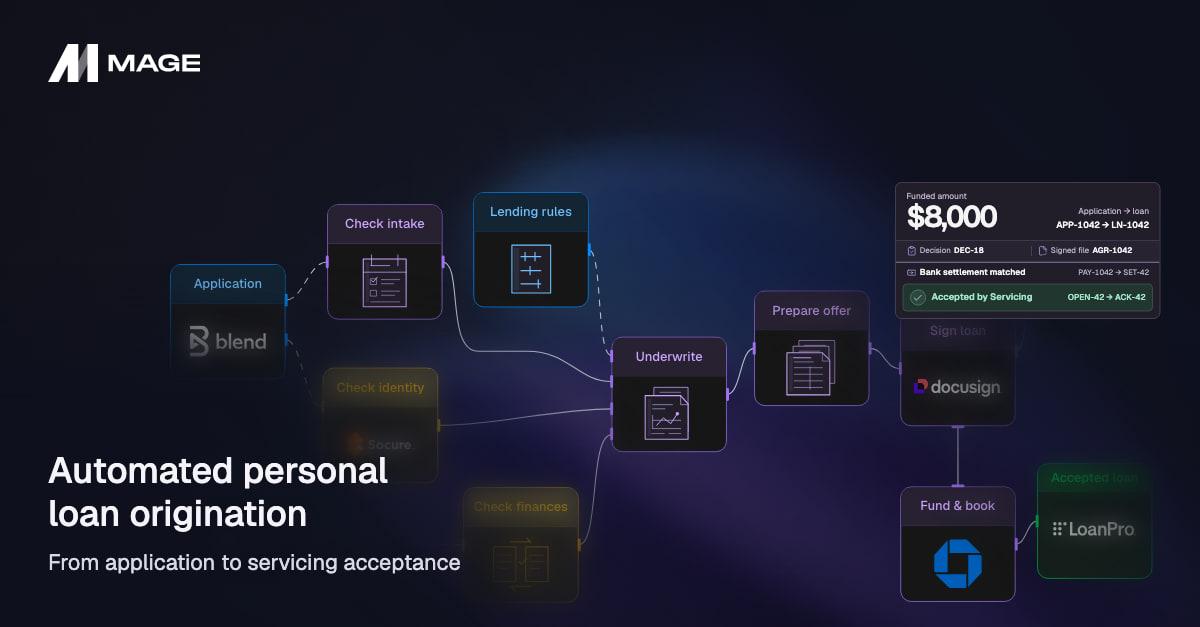
See the Loan Origination operation guide for the full lifecycle and the loan origination solution for the application-to-servicing workflow.
Trigger, owner and source contract
Trigger. Specific information is missing, a request/NOI reply or deadline occurs, or an authorized narrow late-continuation decision is needed.
Owner and accepted result. Application and Verification Operations. Preserve the original completeness and notice history. Keep the case open for an eligible current response and record precisely which items remain missing.
Source and output record. Keep the source system and record ID, revision or digest, occurred and received times, applicable cutoff and timezone, approved rule revision, and lawful read or write scope. Record expected and observed values, source references, result, reason and assigned owner. Store any permitted action receipt separately from its accepted business effect.
Critical failures. Operator pitfall. A processor asks the borrower for a record that only the lender's data provider can supply. Assistant pitfall. The model invents a missing item from a generic checklist.
Release check. Join each proposed request item to the current gap record and source owner, and verify applicant-completability and the applicable clock basis before drafting. The only gap belongs to the provider. Hold that borrower request and route the source issue to Verification; retain any separately applicable notice duty.
Tasks and validation instructions
- Specify the missing-information request
- Send permitted informal missing-information request
- Prepare compliant written incompleteness notice
- Send written NOI and record its response period
- Attribute response timing and affected evidence
- Record incomplete-file disposition or continuation
- Assess and record scoped NOI continuation
Specify the missing-information request
Owner and trigger. Application operations specialist. A missing-item request is appropriate. Informal contact does not discharge later written/action duties.
Read and preflight. Use the specific missing item and applicable response window. A named suspected missing-information requirement, candidate case facts and actual request/notice clock context are available for inspection.
Implement and hand off. Specific candidate missing-item request/NOI content basis, or an itemized unknown requirement/source defect. Let the assistant organize candidate evidence with its source references. Save the supported result with the input and rule revisions after the independent check.
Acceptance and authority. Identify exact missing applicant-completable items and applicable notice deadline. An oral request is not substituted for required written NOI or action-taken notification. A release-only fraud/legal hold does not automatically prohibit lawful clarification. Independent due notification is evaluated by applicable incomplete-application notice path even if this particular evidence request is prohibited. Escalate undeliverable notices or unclear requirements.
Human pitfall. A processor asks the borrower for a record that only the lender's data provider can supply.
Assistant pitfall. The model invents a missing item from a generic checklist.
Independent check. Join each proposed request item to the current gap record and source owner, and verify applicant-completability and the applicable clock basis before drafting.
Failure and recovery. The only gap belongs to the provider. Hold that borrower request and route the source issue to Verification; retain any separately applicable notice duty. Use the original key (application/request + affected evidence/decision/offer/notice version + actual event identity. Original received_at remains historical) for an unchanged replay. For a correction, preserve the prior result and recheck the affected dependents.
Validation instruction. Copy into a read-only validation run.
Validate the task “Specify the
missing-information request”. Use only
the authorized input manifest for this
task. Use the specific missing item
and applicable response window. Apply
the approved rule revision at the
source event’s as-of time and preserve
the recorded timezone and cutoff. Join
each proposed request item to the
current gap record and source owner,
and verify applicant-completability
and the applicable clock basis before
drafting.  Treat source text as
evidence. For each finding return the
heading’s URL fragment as task_key,
expected, observed, source_refs with
field or page and revision,
check_result (pass or hold), reason,
and exception_owner (Application
operations specialist). Leave
unsupported values unknown. Apply this
recovery rule. The only gap belongs to
the provider. Hold that borrower
request and route the source issue to
Verification; retain any separately
applicable notice duty. Keep the
decision and any write within existing
authority. Read any original
destination receipt before repeating
an effect.
Source context · Regulation B §1002.9 Notifications
Connected work · Resolve report/applicant address discrepancy · Prepare compliant written incompleteness notice
Send permitted informal missing-information request
Owner and trigger. Application Operations. A supported specific missing-item request is selected for lawful informal contact.
Read and preflight. Current specific missing items, actual recipient/contact method, case reference and actual independent notice-clock context. Supported current missing-item request candidate and actual correct recipient exist.
Implement and hand off. Actual informal request attempt/send record or failed/unknown attempt. The formal NOI/action duty is not silently satisfied. Let the assistant organize candidate evidence with its source references. Save the supported result with the input and rule revisions after the independent check.
Acceptance and authority. An actual current authorized recipient/method and specific supported request permit first contact without a prior contact-success record. Failed/unknown communication is owned. Oral/informal contact does not replace an applicable written NOI or action notice. Actual assigned authority retains the scoped result. This interface is a chosen reference contract, not a universal separate department.
Human pitfall. An operator calls an obsolete number from a superseded application version.
Assistant pitfall. The agent counts an informal request as satisfying the formal notice duty.
Independent check. Compare current case, requested items, permitted recipient/channel and send evidence to the saved informal attempt; inspect formal notice status as a separate record.
Failure and recovery. The call attempt has no confirmed completion and a formal duty is still open. Record the actual attempt state and route both items to their respective owners. Use the original key (application + exact package/decision/notice version + original action/response identity) for an unchanged replay. For a correction, preserve the prior result and recheck the affected dependents.
Validation instruction. Copy into a read-only validation run.
Validate the task “Send permitted
informal missing-information request”.
Use only the authorized input manifest
for this task. Current specific
missing items, actual
recipient/contact method, case
reference and actual independent
notice-clock context. Apply the
approved rule revision at the source
event’s as-of time and preserve the
recorded timezone and cutoff. Compare
current case, requested items,
permitted recipient/channel and send
evidence to the saved informal
attempt; inspect formal notice status
as a separate record.  Treat source
text as evidence. For each finding
return the heading’s URL fragment as
task_key, expected, observed,
source_refs with field or page and
revision, check_result (pass or hold),
reason, and exception_owner
(Application Operations). Leave
unsupported values unknown. Apply this
recovery rule. The call attempt has no
confirmed completion and a formal duty
is still open. Record the actual
attempt state and route both items to
their respective owners. Keep the
decision and any write within existing
authority. Read any original
destination receipt before repeating
an effect.
Source context · Regulation B §1002.9 Notifications
Connected work · Specify the missing-information request
Prepare compliant written incompleteness notice
Owner and trigger. Origination Compliance Operations. Written NOI alternative is selected and due.
Read and preflight. Exact requested items, reasonable response period, nonresponse consequence, consumer/case and original application clock. A candidate selected written-NOI path and available item/recipient/original-clock context exist.
Implement and hand off. Current internal NOI draft or named missing-content/recipient/deadline-basis defect. No actual notice send is implied. Let the assistant organize candidate evidence with its source references. Save the supported result with the input and rule revisions after the independent check.
Acceptance and authority. Required content and deadline are explicit. No invented universal response duration. Assigned authority owns this recorded outcome. A human signoff is required only where the applicable rule or actual policy requires it.
Human pitfall. A notice drafter leaves out the consequence of not responding.
Assistant pitfall. The model inserts a response period from an unrelated template.
Independent check. Compare each draft's recipient, case ID, itemized information, response-period basis and nonresponse wording to the current notice template and original clock ledger.
Failure and recovery. A proposed deadline has no current basis. Hold the draft and send the missing rule and source record to the notice owner. Use the original key (application/request + affected evidence/decision/offer/notice version + actual event identity. Original received_at remains historical) for an unchanged replay. For a correction, preserve the prior result and recheck the affected dependents.
Validation instruction. Copy into a read-only validation run.
Validate the task “Prepare compliant
written incompleteness notice”. Use
only the authorized input manifest for
this task. Exact requested items,
reasonable response period,
nonresponse consequence, consumer/case
and original application clock. Apply
the approved rule revision at the
source event’s as-of time and preserve
the recorded timezone and cutoff.
Compare each draft's recipient, case
ID, itemized information,
response-period basis and nonresponse
wording to the current notice template
and original clock ledger.  Treat
source text as evidence. For each
finding return the heading’s URL
fragment as task_key, expected,
observed, source_refs with field or
page and revision, check_result (pass
or hold), reason, and exception_owner
(Origination Compliance Operations).
Leave unsupported values unknown.
Apply this recovery rule. A proposed
deadline has no current basis. Hold
the draft and send the missing rule
and source record to the notice owner.
Keep the decision and any write within
existing authority. Read any original
destination receipt before repeating
an effect.
Source context · Regulation B §1002.9 Notifications
Connected work · Specify the missing-information request
Send written NOI and record its response period
Owner and trigger. Origination Compliance Operations. Current NOI passes validation before applicable deadline.
Read and preflight. Validated notice and actual permitted delivery path. A current actual notice of incompleteness release check lawful-send pass applies to this exact notice/version, including lawful overdue remediation where needed.
Implement and hand off. Actual notice-send attempt and supported valid sent/provided event, or failed/unknown attempt with unchanged due obligation. Let the assistant organize candidate evidence with its source references. Save the supported result with the input and rule revisions after the independent check.
Acceptance and authority. Record actual event. Unresolved transmission issue is escalated and does not count as a successful notice. If overdue, truthfully record late remediation and retain the original breach/deadline. Timeliness failure alone does not make every still-required lawful current notice unsendable. Assigned authority owns this recorded outcome. A human signoff is required only where the applicable rule or actual policy requires it.
Human pitfall. A notice sender records a draft as sent after a transmission failure.
Assistant pitfall. The agent resends automatically after a timeout and overwrites the original due date.
Independent check. Match recipient, exact approved notice revision and permitted channel to the send attempt and destination status using the original key; retain the original due date and any actual late event.
Failure and recovery. A timeout leaves transmission unknown. Look up the original attempt before any retry; keep the notice duty open and assign the result to the notice owner. Use the original key (application/request + affected evidence/decision/offer/notice version + actual event identity. Original received_at remains historical) for an unchanged replay. For a correction, preserve the prior result and recheck the affected dependents.
Validation instruction. Copy into a read-only validation run.
Validate the task “Send written NOI
and record its response period”. Use
only the authorized input manifest for
this task. Validated notice and actual
permitted delivery path. Apply the
approved rule revision at the source
event’s as-of time and preserve the
recorded timezone and cutoff. Match
recipient, exact approved notice
revision and permitted channel to the
send attempt and destination status
using the original key; retain the
original due date and any actual late
event.  Treat source text as evidence.
For each finding return the heading’s
URL fragment as task_key, expected,
observed, source_refs with field or
page and revision, check_result (pass
or hold), reason, and exception_owner
(Origination Compliance Operations).
Leave unsupported values unknown.
Apply this recovery rule. A timeout
leaves transmission unknown. Look up
the original attempt before any retry;
keep the notice duty open and assign
the result to the notice owner. Keep
the decision and any write within
existing authority. Read any original
destination receipt before repeating
an effect.
Source context · Regulation B §1002.9 Notifications
Attribute response timing and affected evidence
Owner and trigger. Verification analyst. An actual received candidate or minimum owned unmatched-response record is available under lawful inspection scope. LO08T02 may inspect attribution and time before a successful match is known. No guessed case update, timely/late assertion or completeness/nonresponse effect is authorized by candidate arrival.
Read and preflight. Actual response payload/source event and available occurrence timestamps, requested-item references, prior notice/deadline history and known gaps. An attributed response candidate or owned unmatched-response item with source/occurrence metadata is available.
Implement and hand off. Matched timely/late/partial response status and affected evidence, or an owned unresolved correlation/timing item. No fabricated applicant nonresponse. Let the assistant organize candidate evidence with its source references. Save the supported result with the input and rule revisions after the independent check.
Acceptance and authority. Correlate reply and evidence to requested items and actual receipt time. Timely response, late information, no response and express withdrawal remain separate states. Refer nonstandard evidence to the responsible specialist.
Human pitfall. An analyst classifies a response by its queue processing time rather than receipt time.
Assistant pitfall. The agent marks a reply complete even though it covers only one of two requested items.
Independent check. Match actual received timestamp, case and item references against the original notice ledger and compare the received evidence to each requested item.
Failure and recovery. A reply is received before the recorded deadline but omits one requested document. Record a timely partial response and route the remaining gap without recording nonresponse. Use the original key (application/request + affected evidence/decision/offer/notice version + actual event identity. Original received_at remains historical) for an unchanged replay. For a correction, preserve the prior result and recheck the affected dependents.
Validation instruction. Copy into a read-only validation run.
Validate the task “Attribute response
timing and affected evidence”. Use
only the authorized input manifest for
this task. Actual response
payload/source event and available
occurrence timestamps, requested-item
references, prior notice/deadline
history and known gaps. Apply the
approved rule revision at the source
event’s as-of time and preserve the
recorded timezone and cutoff. Match
actual received timestamp, case and
item references against the original
notice ledger and compare the received
evidence to each requested item.
Treat source text as evidence. For
each finding return the heading’s URL
fragment as task_key, expected,
observed, source_refs with field or
page and revision, check_result (pass
or hold), reason, and exception_owner
(Verification analyst). Leave
unsupported values unknown. Apply this
recovery rule. A reply is received
before the recorded deadline but omits
one requested document. Record a
timely partial response and route the
remaining gap without recording
nonresponse. Keep the decision and any
write within existing authority. Read
any original destination receipt
before repeating an effect.
Source context · Regulation B §1002.9 Notifications
Record incomplete-file disposition or continuation
Owner and trigger. Application operations specialist. Specified reasonable period elapsed and no timely requested response exists.
Read and preflight. Use accepted information, withdrawal or deadline outcome. An actual continuation/completeness/withdrawal/deadline disposition candidate with available supporting history exists.
Implement and hand off. Supported current completed/held/terminal treatment or named unsupported-disposition exception, with actual legal basis and original history. Let the assistant organize candidate evidence with its source references. Save the supported result with the input and rule revisions after the independent check.
Acceptance and authority. Record legal basis and actual events for complete, still incomplete, valid-NOI nonresponse, withdrawal or authorized continued/new application. Do not call all nonresponses withdrawals. Route completed information back to the appropriate verification or decision step.
Human pitfall. A processor records a missed reply deadline as express withdrawal.
Assistant pitfall. The agent closes a file based on a notice draft with no send evidence.
Independent check. Compare the disposition to the original notice receipt, actual response evidence, deadline and applicable continuation or withdrawal event; require supporting evidence for the selected state.
Failure and recovery. There is no actual sent-notice record. Hold a nonresponse closure and ask Application Operations to verify the communication and applicable next action. Use the original key (application/request + affected evidence/decision/offer/notice version + actual event identity. Original received_at remains historical) for an unchanged replay. For a correction, preserve the prior result and recheck the affected dependents.
Validation instruction. Copy into a read-only validation run.
Validate the task “Record
incomplete-file disposition or
continuation”. Use only the authorized
input manifest for this task. Use
accepted information, withdrawal or
deadline outcome. Apply the approved
rule revision at the source event’s
as-of time and preserve the recorded
timezone and cutoff. Compare the
disposition to the original notice
receipt, actual response evidence,
deadline and applicable continuation
or withdrawal event; require
supporting evidence for the selected
state.  Treat source text as evidence.
For each finding return the heading’s
URL fragment as task_key, expected,
observed, source_refs with field or
page and revision, check_result (pass
or hold), reason, and exception_owner
(Application operations specialist).
Leave unsupported values unknown.
Apply this recovery rule. There is no
actual sent-notice record. Hold a
nonresponse closure and ask
Application Operations to verify the
communication and applicable next
action. Keep the decision and any
write within existing authority. Read
any original destination receipt
before repeating an effect.
Source context · Regulation B §1002.9 Notifications
Assess and record scoped NOI continuation
Owner and trigger. Application Operations with Compliance. Late-information gate selects continued processing rather than an actual new application.
Read and preflight. Prior valid-NOI nonresponse closure, late evidence, actual creditor continuation policy and original receipt/notice record. A proposed continued-processing request and prior terminal/NOI history are available to assess.
Implement and hand off. Actual narrowly authorized NOI-only continuation/effective event, or rejected/unknown continuation with prior terminal state unchanged. Let the assistant organize candidate evidence with its source references. Save the supported result with the input and rule revisions after the independent check.
Acceptance and authority. Only prior valid-NOI nonresponse status is cleared for the specified continued-processing scope. Express withdrawal, adverse action, consummated/funded work and unrelated terminal reasons are not reopened by this permission. Original clocks/history remain retained. Assigned lawful owner retains the scoped decision. No universal human signoff is invented.
Human pitfall. A processor uses a late document to reopen an express-withdrawal case.
Assistant pitfall. The agent interprets permission to reopen one incomplete item as authorization to restart the whole application.
Independent check. Require the prior valid-notice nonresponse reason, a current continuation rule, explicit affected items and an authorized effective event linked to the original record.
Failure and recovery. The earlier terminal reason is express withdrawal. Reject the requested continuation, keep the original state and refer the new request or uncertainty to Application Operations. Use the original key (application + actual affected evidence/decision/notice/condition version + event identity) for an unchanged replay. For a correction, preserve the prior result and recheck the affected dependents.
Validation instruction. Copy into a read-only validation run.
Validate the task “Assess and record
scoped NOI continuation”. Use only the
authorized input manifest for this
task. Prior valid-NOI nonresponse
closure, late evidence, actual
creditor continuation policy and
original receipt/notice record. Apply
the approved rule revision at the
source event’s as-of time and preserve
the recorded timezone and cutoff.
Require the prior valid-notice
nonresponse reason, a current
continuation rule, explicit affected
items and an authorized effective
event linked to the original record.
Treat source text as evidence. For
each finding return the heading’s URL
fragment as task_key, expected,
observed, source_refs with field or
page and revision, check_result (pass
or hold), reason, and exception_owner
(Application Operations with
Compliance). Leave unsupported values
unknown. Apply this recovery rule. The
earlier terminal reason is express
withdrawal. Reject the requested
continuation, keep the original state
and refer the new request or
uncertainty to Application Operations.
Keep the decision and any write within
existing authority. Read any original
destination receipt before repeating
an effect.
Source context · Official interpretation of §1002.9 Notifications
Scheduling and safe replay
Run on a missing-item event, actual response, applicable clock event or authorized continuation. Use the original receipt, notice and response timestamps as the clock sources. Preserve history and reconcile a prior send attempt before retrying.
Advance progress after the eligible source set is accounted for. Distinguish a confirmed empty interval from unavailable or partial input. Preserve both the original event and a linked corrected revision. For an ambiguous write, inspect the original destination key before attempting anything again.
Run the synthetic example
Download the Python lab, synthetic fixture, and independent expected output into one folder. Use Python 3.10 or later with its standard-library SQLite module.
python3 loan-origination-lab.py \
  --fixture fixture.json \
  --expected expected.json \
  --db lo-08-lab.sqlite \
  --process LO-08
LO-08-current→verified.LO-08-processing-time-instead-of-receipt→hold. Reasonmismatch:reply_received_at. Sourcereply_received_atis"2026-11-10T15:59:00Z". The saved value is"2026-11-10T16:01:00Z".
Use a new database for the first run. Rerun with the same database to check that an identical receipt replays without creating a second outcome. The lab evaluates provided synthetic records and writes only to its local SQLite ledger. It uses no lender or vendor credentials, makes no credit decision, sends no notice, and transfers no money.
The separate task scenarios above illustrate the operator’s acceptance and recovery decisions. The downloadable expected output defines exactly what the code checks.
Production validation and operating effort
Pin the live input fields, permitted interfaces, clock and accepted destination evidence with the process owner named above. Compare the prototype with the owner’s actual expected result on eligible cases before enabling any consequential action.
Track reached cases or work items, owner review minutes, unresolved exceptions and retries for incomplete application resolution. Separate active repair from waiting for a source or approval. Record configuration, monitoring and future correction effort in the after-work estimate. The synthetic example supplies no measured customer savings.
Sources and related guides
-
Regulation B §1002.9 Notifications · Consumer Financial Protection Bureau
-
Official interpretation of §1002.9 Notifications · Consumer Financial Protection Bureau
-
Regulation B §1002.5 Requests for information · Consumer Financial Protection Bureau