How to automate personal loan disbursement exception resolution
TLDR
Trace the original payout first. Let the authorized exception owner choose a supported remedy after confirming the original cash outcome and allowed action.
How do you recover an uncertain payout without paying twice?
The original submission timed out after the processor may have accepted it. Funding Exceptions traces the original reference before considering any remedy. Keep replacement on hold while the cash outcome is unknown.
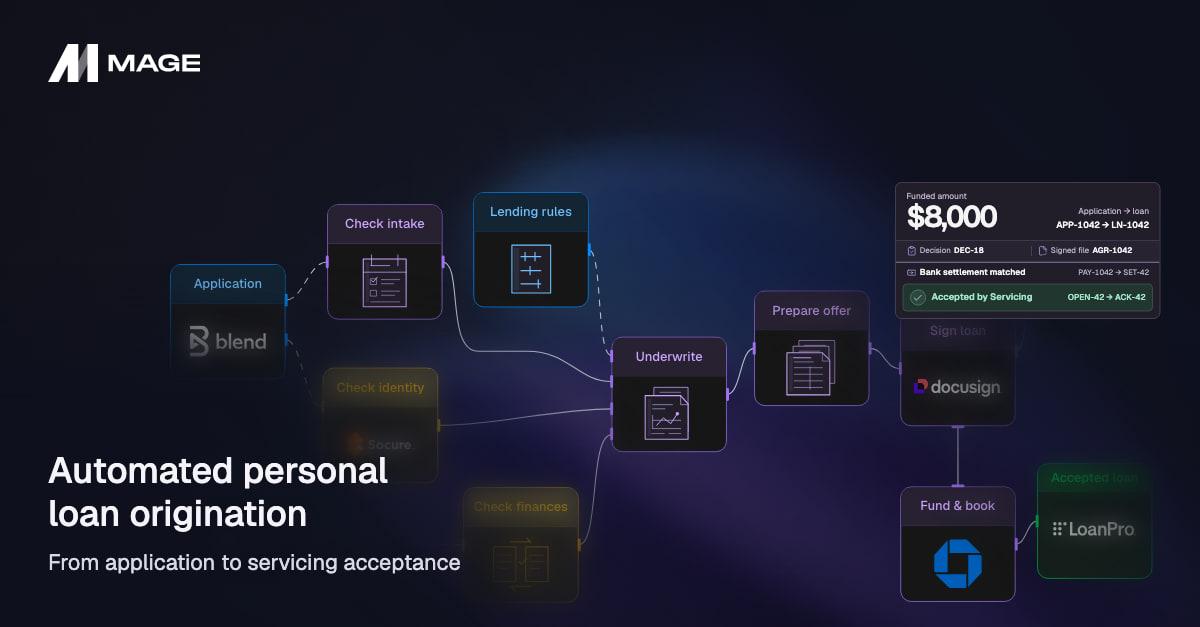
See the Loan Origination operation guide for the full lifecycle and the loan origination solution for the application-to-servicing workflow.
Trigger, owner and source contract
Trigger. Original cash outcome is unknown, rejected, erroneous, returned, later corrected or otherwise needs a scoped payment remedy.
Owner and accepted result. Funding Exceptions. Trace the original payout first. Let the authorized exception owner choose a supported remedy after confirming the original cash outcome and allowed action.
Source and output record. Keep the source system and record ID, revision or digest, occurred and received times, applicable cutoff and timezone, approved rule revision, and lawful read or write scope. Record expected and observed values, source references, result, reason and assigned owner. Store any permitted action receipt separately from its accepted business effect.
Critical failures. Operator pitfall. Starts a new trace without the original reference and cannot reconcile the response. Assistant pitfall. Matches a same-amount response to the wrong original attempt.
Release check. Compare provider inquiry and response with the original reference, intent, amount, currency and permitted source. Preserve unsupported correlations separately. The provider returns two same-amount transfers without the original reference. Keep the outcome unknown and escalate the trace.
Tasks and validation instructions
- Trace, correlate and reconcile payout evidence
- Request a permitted return of settled funds
- Prepare the permitted remedy and affected-owner updates
- Authorize a linked correction or owned closure
Trace, correlate and reconcile payout evidence
Owner and trigger. Funding Exceptions with the payment partner. A payment is uncertain, delayed, rejected, erroneous, returned or subject to a material post-send change.
Read and preflight. Known intent/attempt references OR an owned quarantine/event identity with permitted source context. Available authoritative, weak, unknown or conflicting cash/correlation evidence. Actual source/query permission and timing/key limits. An authorized investigation context exists for a known intent/attempt OR an owned quarantine/event identity and permitted provider/security context.
Implement and hand off. Permitted status/correlation inquiry or owned unresolved hold. Supported attributable original outcome where evidence suffices. New supported candidate association for independent LO-22-T02 validation OR retained quarantine. Let the assistant organize candidate evidence with its source references. Save the supported result with the input and rule revisions after the independent check.
Acceptance and authority. Inspection/preparation is complete when it records a supported accepted OR itemized deficient/unknown/held result. Emit a permitted inquiry, supported original-outcome evidence, new supported correlation evidence for independent intake validation, or a still-owned unresolved/quarantine hold. Investigation itself moves no funds. The assigned owner retains the applicable authority. This does not impose a universal human-only approval.
Human pitfall. Starts a new trace without the original reference and cannot reconcile the response.
Assistant pitfall. Matches a same-amount response to the wrong original attempt.
Independent check. Compare provider inquiry and response with the original reference, intent, amount, currency and permitted source. Preserve unsupported correlations separately.
Failure and recovery. The provider returns two same-amount transfers without the original reference. Keep the outcome unknown and escalate the trace. Use the original key (business intent + original attempt + exception evidence version) for an unchanged replay. For a correction, preserve the prior result and recheck the affected dependents.
Validation instruction. Copy into a read-only validation run.
Validate the task “Trace, correlate
and reconcile payout evidence”. Use
only the authorized input manifest for
this task. Known intent/attempt
references OR an owned
quarantine/event identity with
permitted source context. Available
authoritative, weak, unknown or
conflicting cash/correlation evidence.
Actual source/query permission and
timing/key limits. Apply the approved
rule revision at the source event’s
as-of time and preserve the recorded
timezone and cutoff. Compare provider
inquiry and response with the original
reference, intent, amount, currency
and permitted source. Preserve
unsupported correlations separately.
Treat source text as evidence. For
each finding return the heading’s URL
fragment as task_key, expected,
observed, source_refs with field or
page and revision, check_result (pass
or hold), reason, and exception_owner
(Funding Exceptions with the payment
partner). Leave unsupported values
unknown. Apply this recovery rule. The
provider returns two same-amount
transfers without the original
reference. Keep the outcome unknown
and escalate the trace. Keep the
decision and any write within existing
authority. Read any original
destination receipt before repeating
an effect.
Source context · FedNow Service Operating Procedures version 3.7, effective October 13 2026
Connected work · Check original payout intent and prior attempts · Validate and record authoritative payment events
Request a permitted return of settled funds
Owner and trigger. Authorized payment/exception owner through participating FI. A supported settled-payment error or authorized recovery route requires a return request.
Read and preflight. Original settled payment reference. Reason and authority for the request. Applicable rail request rules and prior request/reply history. Original payment and request basis supported.
Implement and hand off. Nonfinancial return-request record and an owned follow-up obligation. Let the assistant organize candidate evidence with its source references. Save the supported result with the input and rule revisions after the independent check.
Acceptance and authority. Requesting a return does not cancel settled cash or guarantee recovery. Prohibited repeat requests and legal blocking are respected. The assigned owner retains the applicable authority. This does not impose a universal human-only approval.
Human pitfall. Submits a second return request when the first response is delayed.
Assistant pitfall. Treats the return request as cash recovered.
Independent check. Match the rail’s actual return request receipt to the original settlement and the current permitted request key. Reconcile returned cash independently.
Failure and recovery. A return is requested and still pending. Preserve the settled cash state and trace the original request. Use the original key (original payment + authorized return-request version) for an unchanged replay. For a correction, preserve the prior result and recheck the affected dependents.
Validation instruction. Copy into a read-only validation run.
Validate the task “Request a permitted
return of settled funds”. Use only the
authorized input manifest for this
task. Original settled payment
reference. Reason and authority for
the request. Applicable rail request
rules and prior request/reply history.
Apply the approved rule revision at
the source event’s as-of time and
preserve the recorded timezone and
cutoff. Match the rail’s actual return
request receipt to the original
settlement and the current permitted
request key. Reconcile returned cash
independently.  Treat source text as
evidence. For each finding return the
heading’s URL fragment as task_key,
expected, observed, source_refs with
field or page and revision,
check_result (pass or hold), reason,
and exception_owner (Authorized
payment/exception owner through
participating FI). Leave unsupported
values unknown. Apply this recovery
rule. A return is requested and still
pending. Preserve the settled cash
state and trace the original request.
Keep the decision and any write within
existing authority. Read any original
destination receipt before repeating
an effect.
Source context · FedNow Service Operating Procedures version 3.7, effective October 13 2026
Prepare the permitted remedy and affected-owner updates
Owner and trigger. Funding Exceptions. payment remedy review classifies the supported outcome and permitted next action.
Read and preflight. Original cash outcome and exception reason. Applicable rail/partner remedy permissions. Corrected instruction or returned amount. Affected loan/cash/servicing records. An attributable scoped exception/knowledge-state record is available.
Implement and hand off. Supported correction/closure proposal OR itemized investigation/hold/escalation recommendation. Qualified relevant-owner evidence/status. Actual financial treatment remains with the owner. Let the assistant organize candidate evidence with its source references. Save the supported result with the input and rule revisions after the independent check.
Acceptance and authority. Inspection/preparation is complete when it records a supported accepted OR itemized deficient/unknown/held result. Prepare a supported action proposal OR itemized investigation/hold/escalation recommendation and accurate qualified owner evidence. Preparation grants no reissue, return, journal, closure or cash-recovery permission. The assigned owner retains the applicable authority. This does not impose a universal human-only approval.
Human pitfall. Proposes a replacement before the cash outcome or remedy rule is known.
Assistant pitfall. Treats a draft remedy as authority to issue or return money.
Independent check. Compare the proposed action with the confirmed original state, current permitted remedies and the affected loan/cash record versions.
Failure and recovery. Original outcome is unknown. Prepare investigation only and keep replacement, return and closure unavailable. Use the original key (business intent + exception disposition version) for an unchanged replay. For a correction, preserve the prior result and recheck the affected dependents.
Validation instruction. Copy into a read-only validation run.
Validate the task “Prepare the
permitted remedy and affected-owner
updates”. Use only the authorized
input manifest for this task. Original
cash outcome and exception reason.
Applicable rail/partner remedy
permissions. Corrected instruction or
returned amount. Affected
loan/cash/servicing records. Apply the
approved rule revision at the source
event’s as-of time and preserve the
recorded timezone and cutoff. Compare
the proposed action with the confirmed
original state, current permitted
remedies and the affected loan/cash
record versions.  Treat source text as
evidence. For each finding return the
heading’s URL fragment as task_key,
expected, observed, source_refs with
field or page and revision,
check_result (pass or hold), reason,
and exception_owner (Funding
Exceptions). Leave unsupported values
unknown. Apply this recovery rule.
Original outcome is unknown. Prepare
investigation only and keep
replacement, return and closure
unavailable. Keep the decision and any
write within existing authority. Read
any original destination receipt
before repeating an effect.
Source context · FedNow Service Operating Procedures version 3.7, effective October 13 2026
Connected work · Authorize a linked correction or owned closure
Authorize a linked correction or owned closure
Owner and trigger. Authorized Funding/exception owner. A supported remedy proposal and its required approvals are available.
Read and preflight. Reconciled original outcome. Permitted correction or closure proposal. Verified replacement details and retained permissions. Authority covers actual remedy.
Implement and hand off. One supported authorized linked replacement request or confirmed owned closure disposition. Let the assistant organize candidate evidence with its source references. Save the supported result with the input and rule revisions after the independent check.
Acceptance and authority. A replacement must not create duplicate proceeds. New or changed release dependencies return through the normal current release controls. Closure preserves history and remaining obligations. The assigned owner retains the applicable authority. This does not impose a universal human-only approval.
Human pitfall. Signs a correction but forgets to invalidate the old release basis.
Assistant pitfall. Interprets an authorized exception as permission to bypass current controls.
Independent check. Compare the linked original, nonduplication evidence, authorized disposition and new funding dependencies with the delegated decision.
Failure and recovery. Original payout settled and no safe replacement basis exists. Decline the replacement and retain the settlement history. Use the original key (business intent + remedy decision version) for an unchanged replay. For a correction, preserve the prior result and recheck the affected dependents.
Validation instruction. Copy into a read-only validation run.
Validate the task “Authorize a linked
correction or owned closure”. Use only
the authorized input manifest for this
task. Reconciled original outcome.
Permitted correction or closure
proposal. Verified replacement details
and retained permissions. Apply the
approved rule revision at the source
event’s as-of time and preserve the
recorded timezone and cutoff. Compare
the linked original, nonduplication
evidence, authorized disposition and
new funding dependencies with the
delegated decision.  Treat source text
as evidence. For each finding return
the heading’s URL fragment as
task_key, expected, observed,
source_refs with field or page and
revision, check_result (pass or hold),
reason, and exception_owner
(Authorized Funding/exception owner).
Leave unsupported values unknown.
Apply this recovery rule. Original
payout settled and no safe replacement
basis exists. Decline the replacement
and retain the settlement history.
Keep the decision and any write within
existing authority. Read any original
destination receipt before repeating
an effect.
Source context · FedNow Service Operating Procedures version 3.7, effective October 13 2026
Connected work · Prepare the permitted remedy and affected-owner updates · Check original payout intent and prior attempts
Scheduling and safe replay
Run on an unknown, rejected, erroneous or returned original payout event, and on attributable correction evidence. Reconcile the original attempt and cash status at the current cutoff. Apply only a separately authorized linked remedy.
Advance progress after the eligible source set is accounted for. Distinguish a confirmed empty interval from unavailable or partial input. Preserve both the original event and a linked corrected revision. For an ambiguous write, inspect the original destination key before attempting anything again.
Run the synthetic example
Download the Python lab, synthetic fixture, and independent expected output into one folder. Use Python 3.10 or later with its standard-library SQLite module.
python3 loan-origination-lab.py \
  --fixture fixture.json \
  --expected expected.json \
  --db lo-23-lab.sqlite \
  --process LO-23
LO-23-current→verified.LO-23-premature-replacement→hold. Reasonmismatch:remedy. Sourceremedyis"trace_original_hold_replacement". The saved value is"replacement_sent".
Use a new database for the first run. Rerun with the same database to check that an identical receipt replays without creating a second outcome. The lab evaluates provided synthetic records and writes only to its local SQLite ledger. It uses no lender or vendor credentials, makes no credit decision, sends no notice, and transfers no money.
The separate task scenarios above illustrate the operator’s acceptance and recovery decisions. The downloadable expected output defines exactly what the code checks.
Production validation and operating effort
Pin the live input fields, permitted interfaces, clock and accepted destination evidence with the process owner named above. Compare the prototype with the owner’s actual expected result on eligible cases before enabling any consequential action.
Track reached cases or work items, owner review minutes, unresolved exceptions and retries for disbursement exception resolution. Separate active repair from waiting for a source or approval. Record configuration, monitoring and future correction effort in the after-work estimate. The synthetic example supplies no measured customer savings.
Sources and related guides
-
FedNow Service Operating Procedures version 3.7, effective October 13 2026 · Federal Reserve Financial Services
-
Operating Circular4: Automated Clearing House Items, effective January5 2026 · Federal Reserve Financial Services
-
ACH Network Risk and Enforcement Topics: reinitiation clarification · Nacha