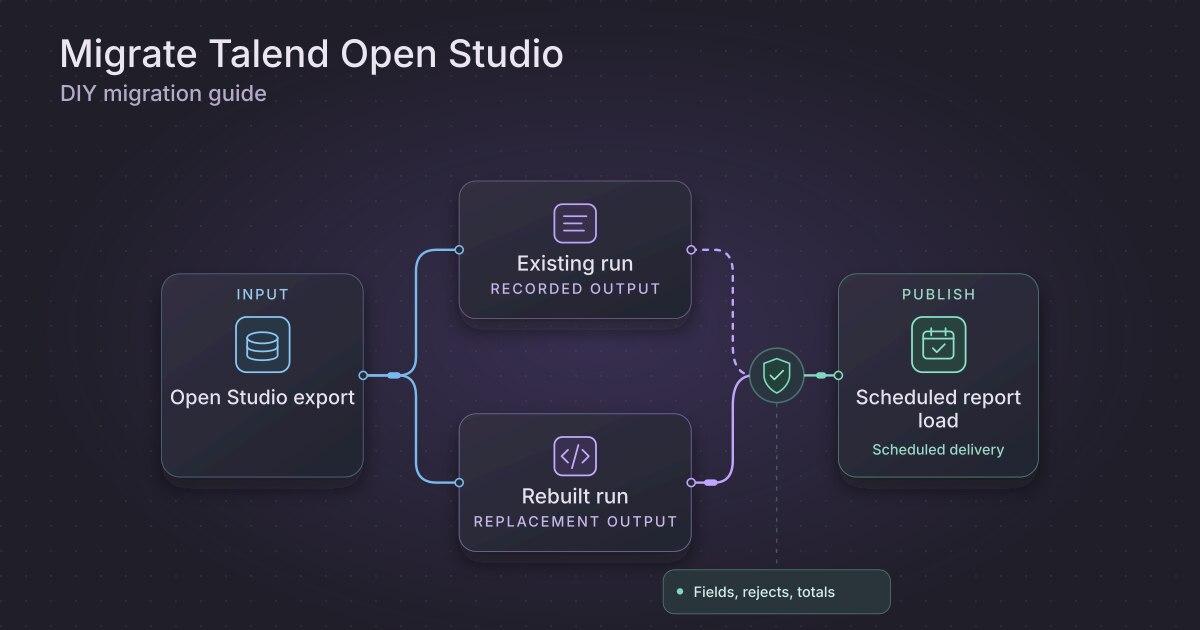
How to migrate a Talend Data Integration Job chain with code and AI
TLDR
Export the commercial Talend parent Job and dependencies, preserve effective contexts, and test every child result before releasing the replacement order feed.
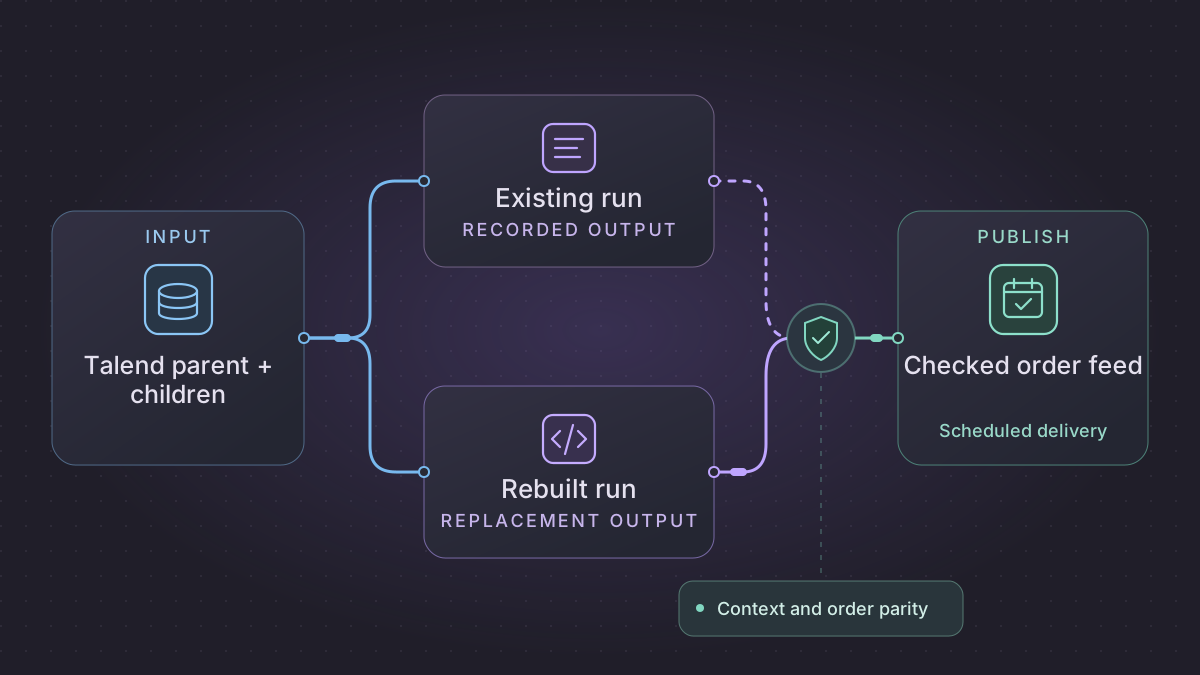
Migrate a Talend Data Integration Job chain by following the parent Job, its child calls, and the context selected at execution. Rebuild one order feed as a few explicit functions or SQL steps. Match the delivered orders and rejected rows before switching the downstream trigger.
Which Talend job and context should you compare before cutover?
The parent Talend Job uses US but its child should route CA orders, or the child times out. Check the effective child context and committed child receipt before choosing a retry or treating a reject as a failed Job.
Recovery. Pin the deployed launcher and explicit tRunJob values. Preserve mapped business rejects and continue only with a committed child receipt. After an uncertain failure, reuse a matching receipt or reconcile the sink. Retry the same context and input only after confirming the write is absent or protected by an atomic receipt or idempotency contract.
Cutover check. Compare parent and child context, tMap accept/filter/reject outcomes, target keys and the actual downstream trigger. In the CA fixture, the two accepted orders total 4,500 cents, the missing lookup remains a reject, and a retried child yields one publication.
Replace a Talend parent and child Job without losing its trigger semantics
The sample inputs and expected results in this walkthrough are synthetic.
Migrate one parent Job, LoadOrders, and the required child, RouteOrders. The target is a versioned order feed and a separate reject file. The source snapshot, lookup version and effective child context must match the Talend run. In this example, the parent carries a default country of US and explicitly passes CA to the child.
Extract a run contract from Studio and the scheduler
| Talend artifact | Write down | Replacement check |
|---|---|---|
Parent .item and .properties, built launcher and task history | Active parent build, business date argument, selected context group, run-as identity and error exit status | The observed scheduler run and the archived launcher name the same Job version. |
tRunJob properties and child source | The effective child version, allowed dynamic choices, context group, explicit parameter expressions and the independent-process flag | Record country=CA, including which parent expression supplied it. Persist the effective context with the run so retries cannot fall back to US. |
tMap join model, lookup and filter expressions | Input and output schemas, lookup snapshot or load mode, match model, inner-join reject flow and output constraint order | Test two rows sharing a lookup key. Do not infer the result from the join keys alone. |
| Trigger arrows and error handlers | Which subjob runs after success, failure or a conditional result, and whether errors can reach tDie | A child business reject can still complete its run. A terminal child error must block publication when the old Job's approved contract requires it. |
| Downstream Job and notification | The commit being observed, output locations, completion token and delivery key | A successful process exit alone does not publish the order feed. |
Use the launcher's context arguments and observed execution evidence to confirm precedence. For tRunJob, explicit child parameters take precedence over inherited values where configured. Pin the resulting non-secret values in a run manifest. Resolve credentials by reference at runtime. Qlik tRunJob properties · Qlik context parameters in standalone Jobs
Implement the Job chain with explicit outcomes
- Register
parent_run(business_date,source_digest,lookup_digest,context_digest)and persist the approved child configuration. Load order rows assource_row,order_id,country,customer_code,amount_text. Pin customer lookup keys and amounts to the two recorded snapshots. - Implement the
tMapoutcomes in a decision table. In this example, a non-CA row is filtered. Missing and duplicate customer mappings are distinct business rejects. Parse amounts to integer cents. Route a connection failure to an attempt error and keep that input out of the reject count. Validate thatread = accepted + filtered + rejectedfor a completed attempt. - Commit accepted rows, rejects and
child_receipt(parent_run_id,child_name,output_version)together. Use a unique parent/child key to fence concurrent retries. Place a durable publishing request behind the receipt. If the child is a standalone worker, the parent reads the receipt from storage rather than depending on an in-memory return value. - Publish only the committed child version. Store feed and reject file digests plus the delivery receipt. Keep the scheduler's overlap and retry limits. Provide an explicit replay for a named input snapshot and a separate authorized revision for a corrected lookup.
Run a fixture that distinguishes three failure paths
Use six input rows for the same business date. O1,CA,C1,30.00 and O2,CA,C2,15.00 are valid. O3,CA,C9,10.00 misses the lookup. O4,US,C1,99.00 is filtered. O5,CA,C3,12.00 finds two C3 mappings. O6,CA,C2,broken has an invalid amount. Expect accepted IDs O1 and O2 totaling 4,500 cents, one filtered row, and rejects O3 NO_CUSTOMER, O5 AMBIGUOUS_CUSTOMER, O6 INVALID_AMOUNT. Compare dispositions as well as totals against the old chain. If the installed Job intentionally chooses one match, exercise its observed order and match model in a separate parity case before proposing a behavior change.
Stop the child after staging to prove the parent has no publication. Retry with the same manifest, then lose the child response immediately after commit. The parent retry must discover the one child receipt, publish one feed, and preserve the same effective country and reject file. At cutover, switch one scheduler task after accounting for in-flight parent and child runs. Retain the last acknowledged outbound batch and the legacy launcher. On rollback, resume only batches that neither system has published.
Export the Jobs and find the effective context
Export the selected Job items from the Studio Repository, with the versions and relevant dependent items. Include child Jobs, shared metadata, routines, and required libraries. Qlik documents exporting repository items as a directory or archive, and the Build Job options distinguish runtime packaging from including the Job source items. Keep the deployed artifact and capture where the effective environment values are applied. Exporting items · Building Jobs
For every tRunJob call, record the child version, context passed, and how its result and failure affect the parent. Trace trigger links and any cleanup subjob. Record the tMap joins, lookups, output filters, and reject paths. Check scheduler-supplied values against the defaults visible in Studio. Keep secrets in your credential store and share context names with AI only after redaction. tRunJob properties · tMap error handling
Rebuild and test the parent-child contract
- Give the replacement one entry point that accepts a business date and approved environment. Validate required settings up front. Isolate development and production destinations through configuration reviewed by the owner.
- Implement the child work as named steps with explicit input and output schemas. Stage accepted orders and rejected rows in separate tables. Record how a child failure affects the parent before writing any final data.
- Validate row counts and totals before publication, then commit the output and batch status together. Keep downstream notification outside the write transaction and make it safe to repeat using the batch key.
Implementation runbook
Export the parent, all children and what the scheduler overrides
In Talend Studio Repository, right-click the parent Job and choose Export items. Use an archive and select Export Dependencies, then inspect it for child Jobs, routines, metadata, contexts and referenced Joblets. Dynamic child selection may require explicitly exporting alternative versions. On the deployed revision also use Build Job where available to capture the runnable archive with the generated launch scripts, configuration and context files. Studio source and the built archive establish different things. Diff their versions against the active run. Qlik Export items · Qlik Build Job
For Talend Administration Center, inspect Job Conductor's active task and, if used, its execution plan with task logs and effective contexts. Record trigger, execution server, context name and overrides, runtime version, schedule/overlap, and child job failures. In each tRunJob inspect selected version, explicit child context, Transmit whole context, Context Param, independent process and error behavior. Explicit child Context Param values override inherited values even with Transmit whole context selected. Inventory OnSubjobOk/OnSubjobError, OnComponentOk/OnComponentError and RunIf separately, plus tDie/tWarn/tLogCatcher and commit/rollback components. Qlik tRunJob properties · Qlik Job Conductor execution plans
Make the parent-child contract executable
- Use a typed config per child with the environment, input snapshot, date/window and stable batch ID. Derive effective config from environment defaults, job/task overrides and explicit parent-child mappings using the observed precedence. Validate on startup and log only sanitized fields. Prefer independent worker processes where the current design relies on process isolation.
- Translate row flows and trigger flows separately. Use SQL for tMap joins and expressions where correct, with a pinned reference table for each business date. Preserve tMap lookup match and reject disposition. A business reject has an exact source row and reason. A technical failure sets a terminal/retryable task state and follows the configured parent path.
- Persist child completion with its target update and ledger when possible. Key by parent batch, child name and input digest. Expose accepted, rejected and failed status and output IDs to the parent. Parent retries should never advance the order cutoff until the required children and outbound receipts are complete. Plan catch-up explicitly when switching triggers.
Concrete fixture. Parent LoadOrders passes date October 20 and default country US. Child RouteOrders receives an explicit country CA. Two valid CA orders with amounts 30.00 and 15.00 are accepted, a third fails tMap lookup and is quarantined, and an explicit exception injects a technical failure after staging. Assert the replacement used CA, kept one reject with its original ID, and published only after the retried child committed. Force a crash after commit and before returning to the parent and verify one target change and one parent-visible receipt for the same logical run.
Run the acceptance logic locally
Run this self-contained fixture with Python 3. It uses synthetic inputs and no vendor connection. For migration signoff, repeat the same checks against a sandbox on your selected replacement.
from decimal import Decimal

parent_context = {"business_date": "2026-10-20", "country": "US"}
child_context = {**parent_context, "country": "CA"}
rows = [("O1", "CA", "30.00", True), ("O2", "CA", "15.00", True),
        ("O3", "CA", "20.00", False), ("O4", "US", "99.00", True)]
commits, parent_receipts = {}, set()

def child_run(run_key, fail_before_commit=False):
    if run_key in commits:
        return commits[run_key]
    selected = [row for row in rows if row[1] == child_context["country"]]
    accepted = {key: Decimal(amount) for key, _, amount, matched in selected if matched}
    rejects = {key for key, _, _, matched in selected if not matched}
    if fail_before_commit:
        raise RuntimeError("Child interrupted before commit")
    commits[run_key] = accepted, rejects
    return commits[run_key]

try:
    child_run("run-20", fail_before_commit=True)
except RuntimeError:
    assert "run-20" not in commits
for _ in range(2):
    accepted, rejects = child_run("run-20")
    parent_receipts.add("run-20")
assert sum(accepted.values()) == Decimal("45.00") and rejects == {"O3"}
assert parent_receipts == {"run-20"}
Replay a small order batch
Set test context region=west and give the parent two valid West orders for 20 and 30, plus a West order with a missing customer code. Under the fixture's rules the child lookup should return two accepted orders, one reject, and a total of 50. Add an East order and verify the environment rule excludes it. Simulate a failed child and confirm no downstream notification is sent. Replay a successful batch and confirm neither target rows nor notifications multiply.
Prompts you can copy
Given this redacted Talend Job tree, context names, trigger links, and tMap excerpts, build a parent-child execution table. Show each parameter source, failure branch, reject output, and downstream dependency. Flag assumptions.
Write a replacement outline and fixture tests for the West order load. Include a child timeout and a notification failure after commit. Make the example run entirely against local files and a temporary database.
Automate the run and move the schedule
Schedule after the inputs arrive, with a lock per date and environment. Retry connection failures within a bounded window and quarantine validation failures for an owner. Compare staged runs using the same source slice and check the downstream signal separately from the order table. When accepted, disable the old task before enabling the replacement. Retain the old artifact and its exact context references through rollback.
Need help with the migration?
Explore Talend Data Integration migration services or browse all DIY migration guides.