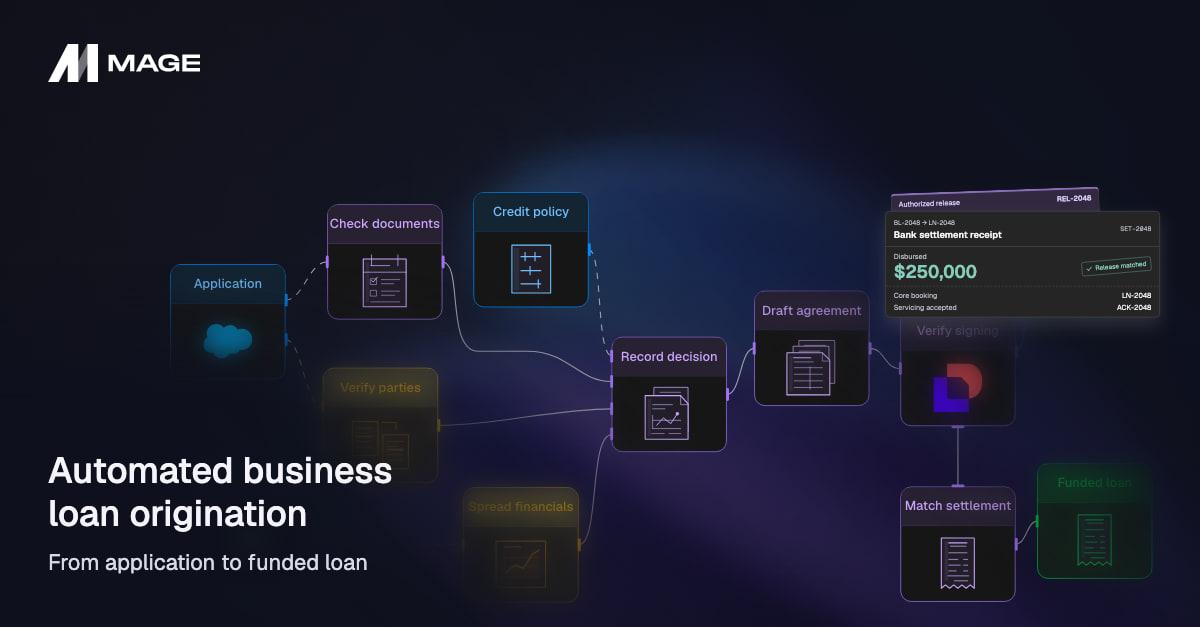
How to automate business loan origination
TLDR
Join the authorized release to the bank settlement receipt before recording a loan as funded. Then confirm the core booking and servicing handoff.
When can a lender mark a business loan funded?
Mark a business loan funded when the approved release matches the bank’s authoritative settlement evidence for the same loan, destination, amount and currency. Loan Operations then verifies core booking and obtains a servicing acknowledgment. If the lender opens a facility without a draw, record availability using the activation evidence for that facility.
For example, a signed agreement and a bank acknowledgment for $250,000 do not establish settlement. Treasury holds the funded status until a final receipt matches the approved release. A receipt for the same amount and a different beneficiary leaves the loan pending reconciliation.
Scope and ownership
This reference design covers U.S. business purpose origination at commercial banks, credit unions and savings institutions, from the first genuine application or authorized new credit action through disposition, booking and servicing handoff. The commercial lending operations owner coordinates the file. Program providers, counsel, signers and authorized officers retain their own decisions and evidence.
Most files move from intake and classification through underwriting and a credit decision. Collateral and outside commitments run when applicable. A decline, withdrawal or an unaccepted offer reaches its own disposition and may leave duties open. Funded and activated deals continue through settlement and core booking. Quality reviews run alongside the main flow. Routine servicing and investor sales begin at separate handoffs.
The example includes a term-loan path and conditional checks for government lending, commercial real estate, and other specialized products. Use this map with the applicable lender policy and current program instructions. Product, charter, jurisdiction, credit decision and actual obligations determine which steps a given file reaches.
Business loan origination process guides
- Business loan application intake · Origination Intake · Task checks
- Business loan policy classification · Lending Compliance · Task checks
- Business loan borrower verification · Business Verification and Compliance · Task checks
- Business loan evidence collection · Loan Processing · Task checks
- Business credit analysis · Commercial Underwriting · Task checks
- Business loan collateral review · Collateral and Closing · Task checks
- Business loan structuring · Commercial Credit · Task checks
- Business loan program eligibility · Program Lending · Task checks
- Business credit decisions · Delegated Credit Authority · Task checks
- Business loan decision notices · Loan Operations and Compliance · Task checks
- Business loan document preparation · Loan Documentation and Legal · Task checks
- Business loan closing conditions · Loan Closing · Task checks
- Business loan lien settlement · Settlement and Legal · Task checks
- Business loan funding reconciliation · Treasury and Funding · Task checks
- Business loan core booking · Core Loan Operations · Task checks
- Business loan file completion · Origination Records and Reporting · Task checks
- Business loan origination quality control · Origination Quality Assurance · Task checks
Where each process can fail
Business loan application intake
Create a new case when the creditor can match a genuine new request to the authorized intake channel and source receipt. A resubmission for the same request should be linked to its existing case.
Human pitfall. A processor retries a case creation after a timeout and creates a second live application.
Assistant pitfall. An agent treats any request from the same business as a duplicate.
Deciding check. Look up the legal creditor, stable source event and actual request in the loan origination system before creating a case. Match its current revision and receipt.
Hold and recovery. The case creation times out but the original request key returns an accepted record. Reuse that record and its receipt, with zero new cases. Reconcile the readback with the original payload. Ask intake to resolve collisions before creating or retrying.
Origination Intake owns this handoff. Open the detailed check.
Business loan policy classification
Assign requirements from the product, purpose, entity, jurisdiction, channel and reached program using the applicable policy revision. Keep unresolved scope on hold before downstream tasks rely on it.
Human pitfall. An operations lead republishes a generic checklist after terms change without reopening affected approvals.
Assistant pitfall. An agent interprets a successful send as acceptance of the new requirements version.
Deciding check. Compare the current requirements manifest with accepted rule, party, product and authority findings. Verify the exact readback for each permitted recipient.
Hold and recovery. Underwriting acknowledges yesterday’s manifest after a change in guarantor. Hold the affected analysis until underwriting accepts the current manifest. Invalidate only dependent outputs. Reconcile the previous delivery and reissue the corrected revision through its authorized route.
Lending Compliance owns this handoff. Open the detailed check.
Business loan borrower verification
Use an identity and authority record only for the specific party, role, purpose and stage it supports. An identity match alone cannot establish signing authority.
Human pitfall. A specialist passes the prior cleared party packet after the guarantor changes.
Assistant pitfall. An assistant marks a pending CDD event verified from the first cash settlement.
Deciding check. Join each accepted identity, ownership, membership, signer and restriction finding by party, scope, version and effective date. Check the recipient’s permitted view and readback.
Hold and recovery. The new guarantor version has pending verification. Publish the scoped restriction to authorized recipients and hold affected reliance. Ask the actual evidence producer to resolve the pending result, then invalidate dependent decisions and publish a corrected view.
Business Verification and Compliance owns this handoff. Open the detailed check.
Business loan evidence collection
Mark the file complete for a particular decision only when the required evidence for that decision has been received and accepted. Preserve the actual completeness event separately from the date a processor reviews it.
Human pitfall. A processor dates completion from a later duplicate upload.
Assistant pitfall. An assistant treats a partially extracted underwriting packet as a legally complete application.
Deciding check. Compare the roster of routinely considered, verified evidence against the accepted requirements and actual receipt times before setting completeness.
Hold and recovery. One normally considered report remains unverified even though the model can calculate a ratio. Retain incomplete or pending status for the affected requirement. Get the accepted source, correct the completeness anchor if supported, and notify analysis and notice owners without altering original receipt.
Loan Processing owns this handoff. Open the detailed check.
Business credit analysis
Release the spread when each material amount has a source period and reconciles to the accepted documents. Keep unsupported income, debt or guarantor support visible for review.
Human pitfall. A reviewer publishes an old credit memo after liability terms change.
Assistant pitfall. An agent turns a proposed risk grade into the effective approved grade.
Deciding check. Compare the current analysis manifest with each accepted evidence version, unresolved exception, retained authority and the proposed terms and reasons being sent.
Hold and recovery. A revised report invalidates a factor cited in the release package. Hold publication of the affected analysis until independently recomputed. Return the change to the responsible analyst and forward the corrected version to decision owners while retaining earlier operative actions.
Commercial Underwriting owns this handoff. Open the detailed check.
Business loan collateral review
Use a value and collateral package tied to the correct property, required reviewer and accepted priority. The appraiser, inspector or outside authority must supply their own evidence where the program requires it.
Human pitfall. A reviewer marks the package complete by counting uploaded reports.
Assistant pitfall. The assistant interprets a recorded pending condition as already resolved.
Deciding check. Compare the classified collateral work plan with accepted independent valuation, lien, environmental, protection and base records. Require a documented authority and stage for any item carried forward.
Hold and recovery. If the current work plan requires a pre-release insurance binder and the package contains only the application, hold the affected release and report that blocking item. Assign the defect to the insurer or owning collateral team. Keep accepted unaffected artifacts and reopen only their changed consumers.
Collateral and Closing owns this handoff. Open the detailed check.
Business loan structuring
Use deal terms that reconcile to the current credit file and permitted authority. Preserve any exception and show which authorized reviewer can decide it.
Human pitfall. A deal team drops a mandatory condition while copying the credit memo into a template.
Assistant pitfall. The assistant moves an approval-stage prerequisite into the closing checklist without policy authority.
Deciding check. Reconcile the proposed decision package to accepted terms, current capacity, current collateral and support findings, and authentic approvals. Compare every open condition with its allowed stage.
Hold and recovery. If the credit review requires a current support finding and the package version lacks one, hold the decision package and name the missing source. Request the exact revised finding, update the versioned package and invalidate only the previous pending decision request that used the changed facts.
Commercial Credit owns this handoff. Open the detailed check.
Business loan program eligibility
Use the authenticated external decision only for its current case, stage, terms and authority. A sent application packet shows a submission. The program decision requires separate evidence.
Human pitfall. A coordinator clears all downstream holds when the SBA loan number appears.
Assistant pitfall. The assistant turns a fee eligibility milestone into a closing or funding release.
Deciding check. Join each original outside event ID, milestone and actual effective timestamp to the exact case and authorized recipient. Confirm the receiving stage uses only supported status and explicitly carries unresolved requirements.
Hold and recovery. If the only new event is an authenticated number assignment, update that milestone once and retain any unresolved credit, document, or funding requirements. Correct a disputed event through its original producer. Replay the milestone under its stable key and reopen only consumers of a materially changed or revoked authorization.
Program Lending owns this handoff. Open the detailed check.
Business credit decisions
Use the exact approved decision package and verify who had authority to decide it. Lender policy determines whether a rules engine may decide an eligible case and which cases require an officer, committee or independent reviewer.
Human pitfall. A lender changes the recorded reason after a notice has been prepared without preserving its source.
Assistant pitfall. An assistant marks a conditional approval as funded.
Deciding check. Match the actual decision action ID, decisive evidence and reasons, terms, effective time, deciding institution and open conditions to the current case.
Hold and recovery. A current approval still has a collateral clearance condition. Record conditional approval and block actions that require final clearance. Recover accepted condition evidence and any new approval required for changed terms. Preserve the earlier decision and reasons.
Delegated Credit Authority owns this handoff. Open the detailed check.
Business loan decision notices
Start with the actual recorded disposition and the reasons supplied by the decision authority. Apply the notice requirements and timing for the reached applicant and credit path. Hold an unmatched draft for correction.
Human pitfall. A processor reuses the notice reasons from a prior applicant.
Assistant pitfall. The assistant invents a reason that sounds consistent with the policy.
Deciding check. Match the notice's recipient, action, actual decision reasons and document revision to the signed decision and authorized delivery route. Read delivery evidence separately.
Hold and recovery. When the approved decision names insufficient cash flow and the draft says limited collateral, hold release and flag the reason mismatch. Ask the decision owner for the actual reasons and regenerate the approved notice revision. After any send, reconcile the original delivery key before retrying.
Loan Operations and Compliance owns this handoff. Open the detailed check.
Business loan document preparation
Prepare documents from the operative terms and approved form versions. Release only the version cleared under the applicable route and preserve the earlier package when a material term changes.
Human pitfall. A closer sends the approved documents for one legal borrower to a different signer's email.
Assistant pitfall. The assistant marks an outbound package as executed because the e-signing platform accepted it.
Deciding check. Match the approved release authority, validated document bundle, signer/recipient set and open conditions to the actual transmission digest and receipt, where reached. Verify any required binding assent separately.
Hold and recovery. If the release authorization permits drafting only, keep the verified package prepared and hold transmission to signers. Obtain the required release authority and verify each recipient. If a stale version was already sent, reconcile its cancellation before reissue.
Loan Documentation and Legal owns this handoff. Open the detailed check.
Business loan closing conditions
Clear only the condition supported by the current signed instrument, authenticated third-party evidence or expressly authorized exception. Tie each clearance to the exact agreement and release stage.
Human pitfall. Closing counts an unchecked row as cleared because the package has no visible warnings.
Assistant pitfall. The assistant checks every condition based on a summary status alone.
Deciding check. Reconcile required condition IDs and current revisions to independent receipts and explicitly approved exceptions for the reached release stage.
Hold and recovery. One missing current approval leaves the release checklist held, even when all other conditions pass. Return the failed condition to its owner and recompute readiness after evidence or an authorized exception.
Loan Closing owns this handoff. Open the detailed check.
Business loan lien settlement
Use the authoritative filing, custody or control result required for the collateral route. If the route allows an outstanding item, retain its explicit authorization, owner and deadline.
Human pitfall. Settlement closes the entire checklist when recorded priority is still pending.
Assistant pitfall. An assistant treats a checklist note as authorization to defer a required duty.
Deciding check. Join completed recording, custody, payoff and settlement evidence to current release dependencies and permitted open post-close items.
Hold and recovery. Without an approved post-close exception, the unresolved priority item blocks release. Get authoritative evidence or an expressly permitted, owned deferral with a due date.
Settlement and Legal owns this handoff. Open the detailed check.
Business loan funding reconciliation
Mark a cash disbursement funded after authorized release and a matching authoritative settlement receipt. A facility activated without a draw needs separate proof of availability.
Human pitfall. An operator counts a same-amount payment to a different beneficiary.
Assistant pitfall. The assistant turns bank acceptance into settled payment.
Deciding check. Join settlement to exact release reference, amount, currency, payee and account. Compare actual ledger posting separately.
Hold and recovery. A same-amount receipt for a different payee leaves the case pending reconciliation and blocks funded status. Find the authoritative matching receipt. Do not resend unless the original outcome and a new authorized action support it.
Treasury and Funding owns this handoff. Open the detailed check.
Business loan core booking
Transfer the loan after accepted core and ledger readbacks match the approved terms and actual settlement or activation evidence. Verify that the receiving team accepted the account and continuing obligations.
Human pitfall. An operator manually rekeys a different interest rate.
Assistant pitfall. The assistant interprets an HTTP success as correctly persisted terms.
Deciding check. Compare core account and ledger readback to facility, approved terms, borrower, version and matched cash or exposure evidence.
Hold and recovery. If the readback rate differs from approved terms, hold servicing handoff and preserve both values. Reconcile the original core write by key and correct through the approved adjustment workflow. Verify new readback.
Core Loan Operations owns this handoff. Open the detailed check.
Business loan file completion
Reconcile the disposition, accepted records and open duties against the applicable record policy. Hand off covered reporting and surviving obligations to the responsible owner and retain each actual acceptance separately.
Human pitfall. A records analyst marks a periodic report delivered when accepting the facility's servicing handoff.
Assistant pitfall. The assistant infers board delivery from the existence of the frozen report, then fills the date with the report generation time.
Deciding check. Match the final origination record to the accepted disposition and exact evidence lineage. Check each receiving owner's acknowledgment against the transferred version and keep independently owned pending events visible.
Hold and recovery. Servicing accepted the account but the quarterly report has a frozen file and no authorized dispatch proof. Mark the facility complete only if its own gates pass, with REPORT_DELIVERY_UNVERIFIED open under the reporting owner. The receiving reporting owner retrieves the independent distribution or meeting record, records true timing and alerts control staff for an actual missed duty without reopening unrelated facility work.
Origination Records and Reporting owns this handoff. Open the detailed check.
Business loan origination quality control
Release a tested control version after the owner accepts its evidence and effective scope. Reconcile pending cases and uncertain writes before replaying affected work.
Human pitfall. An operator resubmits an entire funding batch after the last acknowledgment times out.
Assistant pitfall. The assistant assumes no postings occurred because the orchestration job failed.
Deciding check. Compare every affected payment or booking key to the destination ledger and existing receipt before retry. Reconcile processed, unresolved and untouched identifiers against the incident manifest and track surviving duties independently.
Hold and recovery. The funding request timed out while destination status remains unknown. Hold the payment key with POSSIBLE_PRIOR_COMMIT and prohibit another submission until authoritative status is known. The continuity owner traces the original keys with Treasury or Core Operations, accepts existing receipts, and replays only items proven eligible under the approved incident recovery plan.
Origination Quality Assurance owns this handoff. Open the detailed check.
Validate the loan before funding or handoff
Pick a term loan and freeze the approved terms, required condition list, effective policy, authorized release and bank readback for the same revision. Keep the approval, instruction, bank acknowledgement and settlement as separate states. Treasury owns release and settlement exceptions. Loan Operations owns core booking and servicing acceptance.
Compare loan, case revision, release reference, amount
in cents, currency and destination to the authoritative
bank receipt. Return the source references, expected
and observed values, state, reason, and Treasury owner.
If final settlement is missing, leave the loan pending.
If an attempted write timed out, find the original key
before retry. Do not infer a signature or move money.
Run the synthetic business loan example
Download the Python lab, synthetic inputs, and expected results into one directory.
Run python3 business-loan-origination-lab.py with Python 3.10 or later. The command compares its complete output with the independent expected file and exits with an error on any difference.
The clean case matches release REL-2048 and settlement SET-2048 for loan LN-2048 and 25,000,000 USD cents. The paired cases change a deciding input such as the beneficiary or agreement revision, omit approval or settlement, repeat the same event, submit a new revision, or time out after a local receipt write. The lab reconciles the original receipt before a retry.
The fixture checks local, synthetic evidence and receipt recovery. No live lender, bank, signature, underwriting model or agency interface is exercised. Loan and servicing systems need separate mapping, permission and acceptance checks before a live rollout.
Measure the workload and funding outcomes
Track hands-on time across the documents, decisions and handoffs each application actually reaches. Include exception work, monitoring and corrections in the after-work baseline. Measure funded loans per application cohort and loans that fall out because of an observed, preventable delay or error. A faster task may fund the same loan sooner. Credit any additional funded loan once, using the first preventable cause. Use comparable file populations and measure capacity, conversion and cash cost separately.
Business loan origination automation
Explore the Business Loan Origination solution for the application, credit review, closing and funding workflow.
Primary references
- OCC bank credit life cycle and authority · Figure 1 and Lending Standards and Loan Documentation sections.
- Application and completed application definitions · 1002.2(f) and official interpretation.
- Notification rules and actual reasons · 1002.9(a)-(g) and official interpretation.
- Closing and booking controls and downstream duties · Pre- and Post-Closing Processes.
- Current SBA eligibility authority and closing requirements · SOP 50 10 v8.1 effective October 1 2026 sections A B C and Appendices 10 14 18 20.